The $95 Question: A Strategic Analysis of the Chase Sapphire Preferred Annual Fee
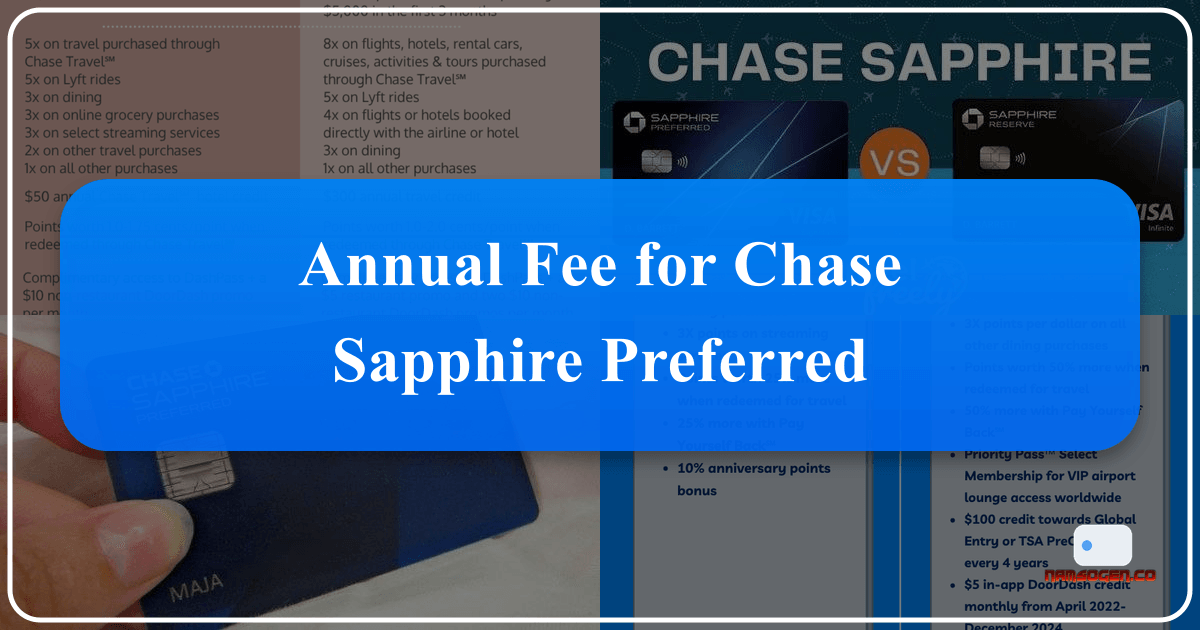
Chase Sapphire Preferred Annual Fee
The Chase Sapphire Preferred (CSP) card holds a unique and powerful position in the fiercely competitive landscape of premium travel credit cards. It is frequently cited as the ideal entry point into the advanced world of travel rewards, offering a compelling blend of high earning rates, robust travel protections, and, most critically, access to the highly valuable Chase Ultimate Rewards (UR) transfer ecosystem. At the heart of the debate surrounding its enduring popularity is its modest annual fee of $95. Unlike many high-tier cards whose fees soar into the hundreds, the CSP’s price tag is intentionally positioned to be accessible yet substantial enough to filter out casual users. The core financial question for any consumer is whether the benefits derived from the card strategically outweigh this annual cost. A thorough analysis reveals that for a user committed to maximizing travel rewards, the $95 fee is not a cost, but a remarkably low barrier to entry for a highly sophisticated travel infrastructure.
I. The Direct Offset: Recouping the $95 Fee
For the responsible cardholder, the $95 annual fee is not only easy to justify but can be directly and automatically offset by utilizing specific features designed by Chase to maintain the card’s long-term value proposition.
1. The Annual Hotel Credit
The most straightforward method to reduce the sticker price is through the annual $50 credit on hotel stays purchased through the Chase Ultimate Rewards portal. This benefit is straightforward: use the card to book a hotel once per cardmember year, and $50 is automatically credited back to your statement. By leveraging this single benefit, the effective cost of the annual fee immediately drops from $95 to a mere $45. This feature is particularly valuable as it encourages engagement with the UR portal, familiarizing the user with the ecosystem where the points are redeemed.
2. The Anniversary Point Bonus
Further enhancing the long-term value is the 10% anniversary point bonus. At the end of each cardmember year, the holder receives a bonus equal to 10% of their total points earned that year. For a cardholder who earns 50,000 points over 12 months (easily achievable through typical spending and travel), this translates into an additional 5,000 points. Given the conservative valuation of UR points at 2 cents per point (especially when transferred to travel partners), 5,000 points equate to roughly $100 in travel value. This single bonus, for a moderately active spender, fully covers the residual $45 cost of the fee, effectively making the card free in the second year and beyond. This mechanism incentivizes continuous, responsible card use.
II. The Strategic Value: Earning and Redemption Power
Beyond the direct offsets, the true worth of the CSP’s $95 fee lies in its sophisticated earning structure and redemption multipliers, which transform common consumer spending into highly valuable travel rewards.
1. Enhanced Earning Categories
The card’s category multipliers ensure that everyday spending generates points at an accelerated rate:
- 3x points on dining: This applies globally, covering restaurants, fast food, and eligible delivery services, which is a major spending category for most consumers.
- 3x points on online grocery purchases: Excluding big-box stores like Walmart and Target, this covers a massive segment of household spending.
- 3x points on select streaming services: Covering popular subscriptions like Netflix, Hulu, and Spotify.
- 2x points on travel: A broad definition that includes flights, hotels, trains, taxis, and tolls.
This elevated earning power ensures that a cardholder maximizing these categories can accrue rewards much faster than a standard 1x point card, generating hundreds of dollars in incremental value annually.
2. The 25% Redemption Boost
The core feature that turns the CSP into a premium tool is the 25% points boost when redeeming points for travel through the Chase Ultimate Rewards portal. A point typically valued at 1 cent suddenly becomes worth 1.25 cents when applied towards flights, hotels, or rental cars booked through the platform. For example, 76,000 points (the initial welcome bonus plus a conservative 1,000 points from meeting the minimum spend) are worth $950 towards travel, a $190 direct value increase over a basic 1 cent per point redemption structure. The $95 fee unlocks this 25% amplification on all earned points, making the fee trivial in comparison to the added value.
III. The Ultimate Advantage: The Transfer Ecosystem
The decisive factor that separates the Chase Sapphire Preferred from all other mid-tier cards is its gateway function to the Chase Ultimate Rewards Transfer Partners. This is the highest value proposition that the $95 fee enables.
Chase maintains 1:1 point transfer partnerships with some of the world’s leading airlines and hotel chains, including United Airlines, Southwest, British Airways, Hyatt, and Marriott. This flexibility allows strategic users to convert their points into partner miles or loyalty currency, often resulting in redemptions valued at 2 cents per point or higher. A 60,000-point bonus, for instance, could be transferred to World of Hyatt for a luxury hotel stay that might otherwise cost $1,200 or more—a clear 2 cent per point valuation.
The ability to transfer points to a diverse roster of partners protects the user from being locked into a single airline or hotel brand, allowing them to book based on availability and strategic need, rather than being forced to accept the fixed 1.25 cent value of the portal. For anyone seeking premium or business-class flight redemptions, this transfer power is non-negotiable, and the $95 fee is simply the membership cost for this elite financial flexibility.
IV. Comprehensive Travel and Purchase Protections
The final justification for the annual fee is the robust suite of insurance and protection benefits that come standard with the card, providing a safety net often superior to that found on many travel insurance policies.
1. Primary Auto Rental Collision Damage Waiver (CDW)
When renting a car, the CSP provides Primary CDW coverage. This is a critical distinction from the secondary coverage offered by many other cards. Primary coverage means the CSP’s insurance kicks in before your personal auto insurance, saving you from filing a claim that could increase your personal insurance premiums. This single benefit can save hundreds or thousands of dollars in a single accident scenario, easily dwarfing the $95 fee.
2. Trip Protection Benefits
The card includes comprehensive Trip Cancellation/Interruption Insurance (reimbursing up to $10,000 per person/per trip for pre-paid, non-refundable travel expenses if a trip is cancelled or cut short for a covered reason), and Trip Delay Reimbursement (providing up to $500 per ticket for reasonable expenses if a trip is delayed by 12 hours or requires an overnight stay). These protections provide peace of mind and are highly valuable during unexpected travel disruptions, a common occurrence in modern air travel.
V. Conclusion: An Investment, Not a Cost

sapphire preferred fee.
The Chase Sapphire Preferred’s $95 annual fee, when viewed in isolation, might seem like an unnecessary expense. However, when evaluated against the totality of the card’s features, it transforms into a highly strategic investment.
The fee is easily offset by the $50 annual hotel credit and further amortized by the 10% anniversary bonus. Its true value, however, lies in unlocking the 25% point redemption bonus and, most crucially, the flexible 1:1 transfer partnerships. For the diligent traveler or rewards optimizer, the fee grants access to a powerful platform that generates value far exceeding the cost, effectively making the CSP the most valuable entry-level premium travel card on the market. It is a fundamental tool for anyone looking to optimize their spending and transform it into high-value travel experiences.